 English
 French
One of the key problems with the Kiss was that its MPU board was non-functionning when we first tried to start it up. It took us quite a while to fix it, because the failures where numerous, spread across many areas and inter-related. We saw all sorts of symptoms, but the initial was that we didn't get a single blink on the LED (it was permanently on). Signal levels were abnormal all over the board (some ICs were receiving +5V DC on pins which shouldn't have had such levels, other were apparently grounded, and then the oscilloscope showed a lot of noise everywhere). The board was badly corroded at the bottom, so we began by changing all the IC sockets at the bottom of the board (we had black bakelite ones). Hint: to remove them easily, start by crushing them into tiny pieces using a pair of cutting pliers. Since they're sort of bakelite, they will nicely break, freeing the individual pins which can then be removed one by one by heating the bottom of the pin on the component side with the soldering iron tip and then quickly lifting it up when the solder melts. Remove the remaining excess solder with a desoldering pump (prefer the mechanical ones, electric ones tend to destroy tracks on these old boards. Iron on one side of the board and pump on the opposite one, here you go). See pictures here: 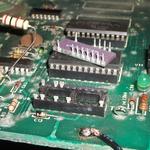
It then turned out the reset circuit was dead (corroded, R11 was toast, so was Q5...). We used this fixture from pinrepair, replacing the whole circuit with a DS1811. This solved our reset issues. We then had to resort to the logic analyzer to figure out what was not working (we had random number of blinks and erratic behavior). The analyzer helped us studying each signal and figuring out which were abnormal, fixing the issues individually. Detailing the process would be too long, but here's a summary of what we had to change to get the board back in working condition:
This brought the MPU back to life! Here's a picture of the board: 
On the solenoid board, we had to re-replace C23. 10,000µF wasn't enough, the MPU board kept rebooting and couldn't stabilize. We changed it for a 15,000µF, which fixed this issue. The machine is now starting, but we have new issues (some coils aren't working, seems some coils are triggered when others should, displays are not working, etc...). More fun ahead ;) Update: Turns out the PROMs on U1 and U2 are PROMs for a Paragon. This probably explains a lot of the weird behavior. We're gonna replace them with proper EPROMs.
|
|||
PinballsStories of little silver balls |
LanguagesNavigation |
|
 |